
Solar and wind without storage is like a tank without an engine - Explaining the bottleneck
Denmark's electricity system is undergoing a fundamental change. Where energy production was previously based on large, central power plants that could be tu...
Denmark's electricity system is undergoing a fundamental change. Where energy production was previously based on large, central power plants that could be turned up and down as needed, a growing share of electricity today comes from decentralised solar parks and wind turbines. This transition means that production depends on the weather rather than on consumers' immediate demand.
The challenge is that the timing of production and the consumption profile rarely align perfectly. That creates a structural imbalance in the electricity grid. This article explains why energy storage is an important component for making better use of renewable energy, where the bottlenecks arise, and what this development means for industrial facilities with high electricity consumption.
Why we produce more renewable electricity than we can use at once
Electricity is not a physical good that can simply be placed in a traditional warehouse. The electricity market is designed to balance supply and demand hour by hour. At any given time, a quantity of electricity must be produced that matches consumption as closely as possible.
When the wind blows strongly at night, or the sun shines from a clear sky in the middle of the day, production from renewable sources often exceeds current consumption. Industry may be running at reduced load overnight, and private households use the least electricity in the middle of the day. The result is an oversupply of electricity in specific periods. Because production cannot be stored in the electricity grid itself, there is a need either to shift consumption, export the electricity, or store it for later use.
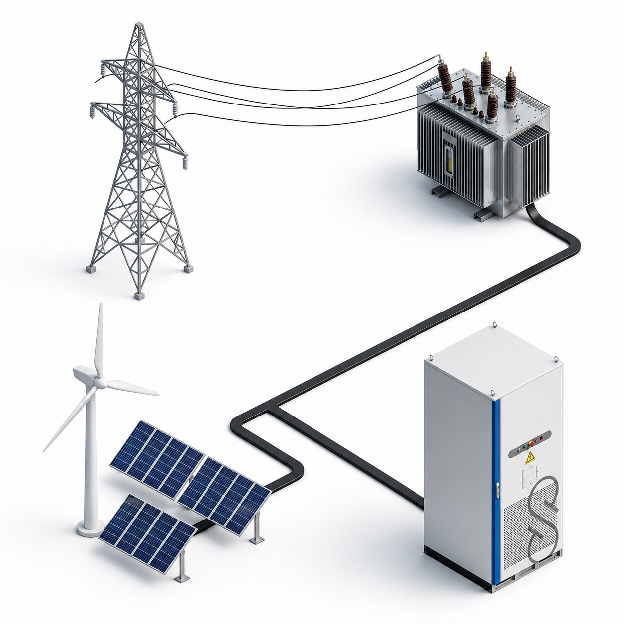
The bottleneck is in the system, not in production
When challenges with renewable electricity are discussed, the problem is rarely a general shortage of energy. The real bottleneck is the system's ability to move and absorb that energy. The electricity grid increasingly functions as a bottleneck for connecting both new production and new demand.
The capacity of the physical cables and substations sets an absolute limit on how much energy can be transported from the production site to the consumer at a given time. If a large solar park produces at maximum, and the local grid does not have capacity to carry all the electricity away, local congestion arises in the network. This phenomenon is called grid congestion. It means that even though the energy is available and inexpensive to produce, it cannot reach the places where it is needed, because the infrastructure lacks the necessary capacity.
What happens to surplus electricity today?
When supply exceeds demand, the electricity does not disappear into thin air. It is handled primarily through market mechanisms, exports, and system operation.
In the first instance, the market tries to place the electricity in neighbouring countries. Through European market integration, cross-border capacity is allocated implicitly in price formation, which means electricity flows toward the areas where price and demand are highest, provided there is spare capacity in the interconnectors.
If export capacity is exhausted and there is still oversupply in a price area, prices fall significantly. In periods of extreme imbalance, very low or negative prices can occur. This is an economic signal that the system lacks flexibility. Negative prices give producers an incentive to stop production and consumers an incentive to increase consumption. If the imbalance cannot be resolved through price, it may become necessary to down-regulate production directly. The energy is therefore either moved to other areas, used later, or down-regulated as part of the system's normal handling of imbalances.
Batteries as the missing link in the energy chain
To address the timing problem and make better use of renewable energy, short-term flexibility is needed. Here, industrial battery storage functions as an important buffer. Batteries are among the most practical tools for short-term flexibility, because they can absorb energy in surplus hours and release it again when demand rises.
An industrial BESS installation does not change the total amount of energy in the system. It changes when energy is drawn from or sent out onto the electricity grid. By storing surplus electricity locally, batteries can relieve the grid in the hours when the cables are most loaded, and deliver electricity in the hours when production from solar and wind is low.
What it takes to address the problem nationally
At national level, integrating more renewable energy requires a combination of substantial grid expansion and increased system flexibility. Energinet, Denmark's national transmission system operator, is responsible for maintaining balance and stability in the electricity system. This is done in part by procuring system services from actors that can regulate their production or consumption at very short notice.
Battery installations at industrial scale can be an important part of this solution. Because batteries can respond very quickly, they are well suited to delivering frequency stability and other fast flexibility to the electricity system. Energinet's introduction to system services, needs assessment for system services, and tender conditions for system services for delivery in Denmark show that access to these markets depends on technical requirements and prequalification before an actor can deliver system services. Batteries should therefore be seen as a supplement to grid expansion and other flexibility solutions, not as the only path to relieving bottlenecks.
Limitations and assumptions
Although battery storage is an effective tool, it is important to understand the technology's limitations. An industrial BESS installation is designed for short-term storage and cyclic operation, and its value also depends on tariff structures, price volatility, and local grid conditions that affect the gain from shifting consumption or relieving the grid.
Batteries do not solve the problem of seasonal variation. They cannot store solar energy from July for use in December. Longer-term storage needs require other technologies. In addition, the value of a battery installation is closely tied to volatility in electricity prices and tariff structures. If the price differences between day and night become very small, the economic gain from shifting consumption falls correspondingly.
What it means for companies with a large grid connection
For manufacturing companies with high electricity consumption, a BESS installation can support more stable and predictable operations, because it can shift parts of consumption away from the most expensive or most congested hours. It can at the same time reduce pressure on the company's grid connection and create better utilisation of local production from solar and wind.
If you want to discuss battery storage options in an industrial context, you are welcome to contact ZynexGroup.