
What is industrial battery storage, and why is it relevant for your business?
Denmark's electricity system is undergoing a structural shift. Where generation previously came from large central power plants that could ramp up and down o...
Denmark's electricity system is undergoing a structural shift. Where generation previously came from large central power plants that could ramp up and down on demand, a growing share of electricity now comes from distributed solar parks and wind turbines. That transition means production follows the weather rather than consumers' immediate needs.
For industrial businesses with high electricity consumption, this creates new operating conditions. Tariffs in the electricity system vary between grid areas, and Danish electricity prices are sensitive to conditions in neighbouring countries and can change from hour to hour. In that context, the ability to control when a facility draws power from the grid becomes a central parameter for operating economics. That is where industrial battery storage enters the picture.
This article explains what an industrial battery energy storage system is, how the technology works in practice, and what commercial consequences it has for a business. It also covers the technical prerequisites for an installation and the clear limitations that determine whether the technology is relevant for a given facility.
What is industrial battery storage in practice?
An industrial battery energy storage system, often referred to as BESS (Battery Energy Storage System), is a large-scale system designed to store electrical energy so it can be used later. Unlike the batteries in electric vehicles or consumer electronics, an industrial BESS is sized to handle large volumes of power and integrates directly into a company's existing electrical infrastructure.
When a system is installed on a company's own site, the placement is typically behind the meter. The difference between a behind-the-meter and a front-of-meter battery is decisive for how the system functions. A front-of-meter system is typically owned by utilities or independent power producers and serves solely to balance the wider electricity grid. A behind-the-meter system, by contrast, connects to the company's internal network. That means the system primarily optimises the company's own consumption, reduces local peak loads, and minimises the costs associated with drawing power from the public grid.
A complete BESS is not only the battery cells themselves. It is an integrated system of hardware and software that work together to ensure safe and efficient operation. The physical footprint ranges from outdoor cabinets to large shipping containers, depending on the required capacity.
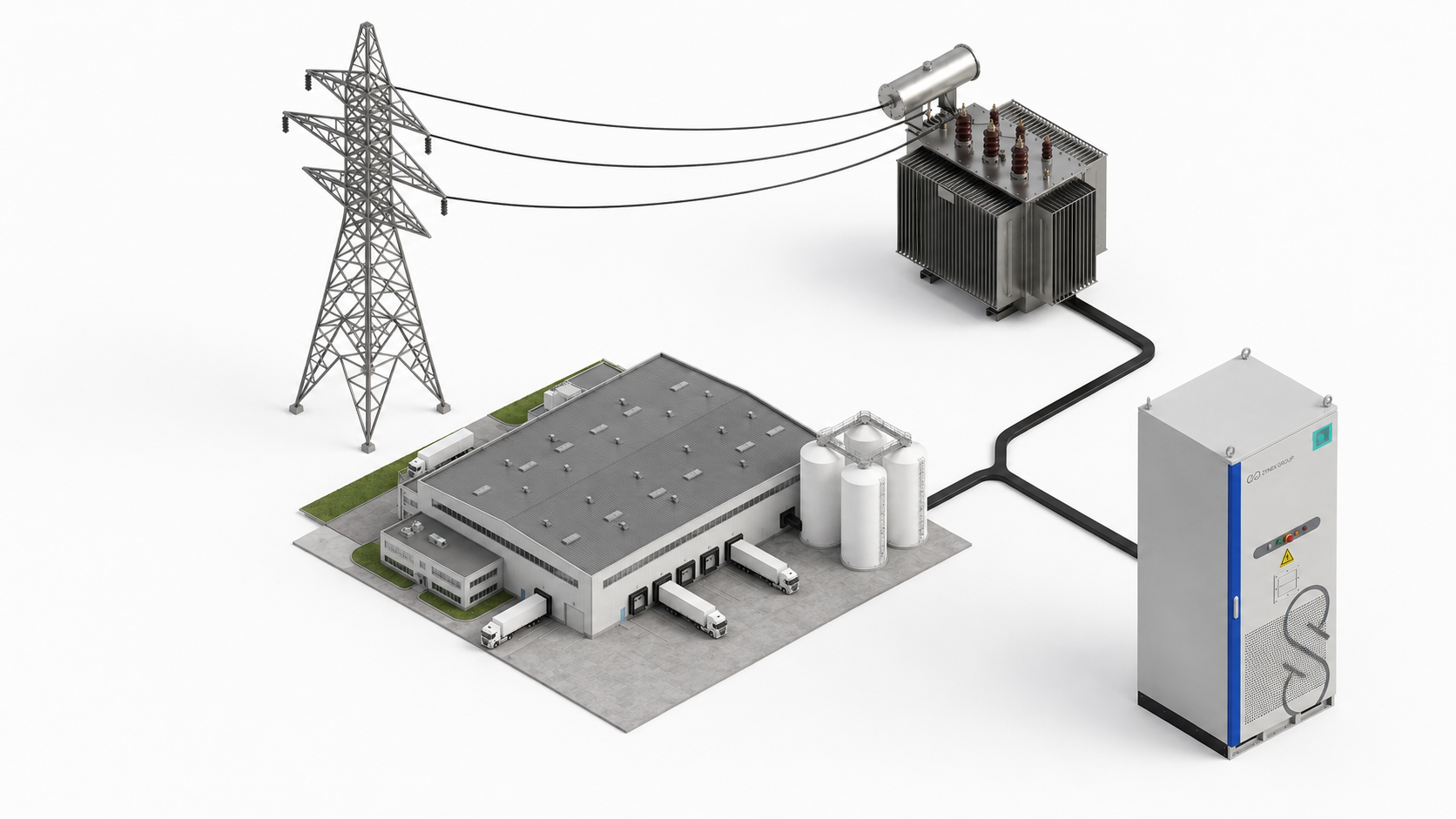
The technical mechanism behind a BESS
To understand how a BESS creates value, it helps to know the main components and their roles. A system consists of three primary elements.
Battery pack: This is the storage medium itself, most often based on lithium-ion technology. The pack comprises thousands of individual cells assembled into modules and then into larger racks. This is where electrical energy is stored chemically.
Power Conversion System (PCS): The grid and the company's machines run on alternating current (AC), while batteries store and release direct current (DC). The PCS unit, also called an inverter, acts as the link. It converts AC from the grid to DC when the battery charges, and converts DC back to AC when the battery discharges and power is used on site.
Battery Management System (BMS): This is the system's internal safety and control layer. The BMS continuously monitors each cell's temperature, voltage, and current. If a cell becomes too hot, or if voltage moves outside permitted limits, the BMS intervenes to protect the system. It also ensures cells charge and discharge evenly, which is important for maintaining system lifetime.
When these components work together, the system can respond in fractions of a second. How a BESS communicates with the grid depends on the overarching software layer, which receives price signals, grid frequency measurements, and data on the company's current consumption. From that data, the system makes automatic decisions about whether to charge from the grid, discharge into the company's production, or deliver services back to the electricity grid.
Understanding power and capacity
One of the most important technical distinctions when sizing a system is the difference between power and capacity. These two concepts are often confused, but they serve different functions.
The difference between power and capacity in a BESS can be explained with a simple analogy. Power is measured in kilowatts (kW) and corresponds to the thickness of a water hose. It defines how much electricity the system can deliver or receive at a given moment. Capacity is measured in kilowatt-hours (kWh) and corresponds to the size of the water tank itself. It defines how long the system can deliver that power before it runs out of energy.
If a company has machines that require a very high power draw for short periods, it needs a system with high power (kW). If the company instead wants to shift its general consumption from day to night over many hours, it needs large capacity (kWh). The right balance between these two parameters is decisive for the system's economic viability.
Why the topic is relevant for Danish businesses
The relevance of industrial battery storage in Denmark is closely tied to developments in the national energy infrastructure. As noted in the introduction, the transition to renewable energy creates a structural imbalance, because production does not always match consumption.
When the wind blows hard at night and consumption is low, electricity prices fall sharply. Conversely, prices rise in the hours when industry runs at full pace and people return home from work, especially if there is little wind. That volatility in electricity prices creates an economic incentive to shift consumption in time.
At the same time, the physical electricity grid is under increasing pressure. The Danish Energy Agency (Energistyrelsen) describes flexibility as a tool for cost-effective expansion of the electricity grid, and the IEA points to grid congestion as a growing bottleneck for new electricity resources. Capacity in the cables and transformer stations that transport electricity is fully utilised in many places. To manage this, grid companies increasingly use time-differentiated tariffs and power tariffs. That means companies pay more to draw power in periods when the grid is most loaded, plus a charge based on their highest measured consumption peak (peak load) over a month or a year.
The need for flexibility in the electricity system is expected to grow over time. For businesses, that means the cost of the raw electricity itself may in future make up a smaller share of the total electricity bill, while tariffs and charges for loading the grid at the wrong times may take up more. A BESS gives the company a tool to navigate this reality by decoupling the moment electricity is purchased from the moment it is used.
Commercial consequences and operational value
When the technical mechanisms are put into operation, several specific use cases open up that directly affect a company's operating economics. An industrial BESS typically generates value through three primary strategies.
Peak shaving
Many industrial facilities have uneven electricity consumption. When large machines start up, or when several production lines run at once, short but very high power draws occur. These peaks are expensive because grid companies charge power tariffs based on the company's maximum draw.
Peak shaving works by having the BESS monitor the company's total electricity consumption in real time. When consumption approaches a predefined limit, the battery automatically begins to discharge. That means the extra power the machines require is supplied by the battery instead of being drawn from the grid. The result is that the company's visible power draw from the grid stays at a more stable level, which reduces power tariffs substantially.
Load shifting
Where peak shaving reduces short, high peaks, load shifting moves larger volumes of energy over time. The strategy uses fluctuating spot prices on the electricity market.
The system is programmed to charge from the grid at night or during midday hours when solar and wind production is high and prices are low. The stored energy is then held in the battery until prices rise, typically in the morning and early evening. At those times, the company's production is supplied wholly or partly by the battery. The company therefore uses the same amount of energy as before, but the average purchase price per kilowatt-hour falls.
Frequency regulation and system services
Beyond optimising internal consumption, a BESS can also participate actively in the markets that keep the national electricity grid stable. The grid must constantly be held at a frequency close to 50 Hertz. If production falls unexpectedly, or consumption rises suddenly, frequency drops. If the opposite happens, frequency rises.
Energinet (Denmark's national transmission system operator) pays actors to stand ready with capacity that can respond quickly to these fluctuations. The IEA highlights battery storage as one of the most versatile technologies for short-term flexibility and system services, because batteries can change their output very quickly compared with many other energy sources.
When a system is enrolled in these markets, the company makes part of the battery's capacity available to the grid. If frequency falls, the battery discharges power to the grid. If frequency rises, the battery charges from the grid. The company is compensated financially for providing this flexibility, which creates an additional revenue stream that can improve the system's overall payback period.
Developments in Europe show that this type of market participation is becoming more widespread. Companies that combine internal optimisation with external system services can strengthen their overall operating economics; for related reading, see our overview of experience from the European BESS market. At the same time, new frameworks for industrial actors that want to participate in these markets are taking shape; we cover this further in our article on the EU electricity market reform.
Lifetime and operational maintenance
An important commercial consideration is the system's expected lifetime. A battery system does not last forever, and its performance declines gradually over time. This phenomenon is called degradation.
Factors that affect a BESS lifetime can be divided into two categories. The first is calendar degradation, which is the natural ageing of battery cells over time, whether they are used or not. The second is cycle degradation, which depends on how the system is used.
Each time a battery is fully charged and fully discharged, it completes a full cycle. The more cycles the system runs, and the deeper those discharges are (Depth of Discharge), the faster the cells wear. Temperature also plays a decisive role. If battery cells operate at too high temperatures, chemical breakdown accelerates. That is why industrial systems are equipped with advanced cooling systems that keep temperature stable, typically around 20-25 degrees Celsius.
To support a long lifetime, the system is often sized so it does not need to run from 0 to 100 percent every day. By keeping operation within a gentler range, for example between 10 and 90 percent of maximum capacity, the system's lifetime can be extended considerably. This is always factored into the initial economic calculations.
Technical prerequisites and clear limitations
Although the technology offers meaningful benefits, industrial battery storage is not a universal solution for every business. Specific technical and operational prerequisites must be met, and there are scenarios where an investment cannot be justified.
Physical and electrical requirements
First, a BESS requires physical space. Depending on capacity, the system can occupy anything from a few outdoor cabinets to several 20-foot containers. The placement must comply with applicable fire requirements and safety distances to existing buildings.
Second, the company's existing electrical infrastructure must be able to handle the system. There must be sufficient capacity in the local transformer and in the main switchboard to integrate the battery's power. If an installation requires a complete replacement of the company's main transformer or extensive excavation to run new cables, project costs can rise to a level where the economics lose their attractiveness.
When BESS is not the right solution
It is equally important to understand when a BESS is not the right solution. The technology creates value through flexibility and variation. If those elements are missing from the company's operations, the business case disappears.
Flat consumption profiles: If a company has completely constant electricity consumption around the clock, every day of the week, there are no peaks to shave. There are also no periods of low consumption where the battery can charge with cheap electricity for later use without oversizing the grid connection. In such cases, the system will struggle to pay for itself through internal optimisation.
Overall energy consumption too low: Industrial BESS installations are capital-intensive. There are fixed costs associated with installation, integration, software setup, and grid connection, regardless of system size. If the company's total electricity bill is relatively small, the potential savings in absolute terms will not be large enough to cover the fixed establishment costs within a reasonable number of years.
Missing export capacity: If the company primarily wants to earn revenue from frequency regulation, the local electricity grid must have capacity to receive the power the battery sends back. In areas with widespread grid congestion, the grid company may refuse permission to export power to the grid. Without that permission, it is not possible to deliver system services, which removes a material revenue source.
ZynexGroup's approach to system assessment
Because the value of a BESS depends entirely on each company's specific data, we work from a strictly analytical process. It is an internal assessment process, not a general industry model, and it is not based on averages or rules of thumb.
Our process always starts by collecting the company's historical consumption data, typically in 15-minute intervals from the past year. That data is combined with information on the current grid connection, the applicable tariff structures in the specific supply area, and the company's physical constraints.
From that data foundation, we map the precise pattern in electricity consumption. We identify when peaks occur, how high they are, and how long they last. We also analyse how much of consumption can realistically be shifted to cheaper hours. This analysis forms the basis for sizing the system's power (kW) and capacity (kWh) correctly, so the company neither pays for overcapacity nor receives a system that is too small for the task.
Once a system is in operation, the focus moves to continuous operational monitoring. Through cloud monitoring of the battery's data, we follow the system's condition in real time. We monitor parameters such as State of Charge (SOC), State of Health (SOH), cell temperatures, and system efficiency. This helps ensure the system operates within safe design limits, and that any deviations are handled before they develop into operational disruptions.
Based on data-driven sizing and operation, we assess the system's expected economics from the concrete operating data and framework conditions. The focus is on whether the possible savings and revenues can realistically offset the system's establishment and operating costs under the agreed assumptions. If you want to discuss a concrete system assessment process, you can contact us here: Contact us.
Overall perspective
Industrial battery storage has moved from being a future technology to being a concrete operational tool for businesses with high electricity consumption. The development is driven by an electricity system in transition, where the ability to shift consumption in time is rewarded economically, while a lack of flexibility is penalised through rising tariffs and price swings.
A BESS does not change how much energy a company uses, but it changes fundamentally how and when that energy is drawn from the grid. Through peak shaving, load shifting, and participation in frequency markets, the technology gives the company control over its energy costs.
It remains important to recognise that the technology requires the right prerequisites. An investment is best based on a thorough analysis of the company's actual consumption data, physical constraints, and grid connection. When those elements are in place, an industrial BESS is a durable method for strengthening the company's energy infrastructure for the years ahead.
Assessing potential
An assessment of industrial battery storage should always start from the company's concrete consumption data, grid connection, and physical constraints. Once those factors are known, it becomes possible to determine whether a BESS has a clear technical and economic foundation.